Skip to the timeline
Kearney & Trecker

Kearney & Trecker of Milwaukee

For most of the twentieth century Kearney & Trecker built milling machines in West Allis, beside Milwaukee, and sold them under the name Milwaukee.

Its knee-type Model K and Model H machines of 1935 worked in American war plants, and in 1942 the firm made more than twelve times a normal year’s output. This timeline follows it from a rented shop in 1898, through the war, to the Milwaukee-Matic machining centre of 1958 and the firm’s absorption into Giddings & Lewis. It is drawn from the firm’s own literature, the trade press, government records and the other sources listed with each event.

Founding

Kearney and Trecker open a shop on Lake Street

Edward J. Kearney, from Iowa, and Theodore Trecker, from Illinois, meet in about 1894 at Frank Kempsmith’s milling-machine works in Milwaukee: Kearney works in the drawing room, and Trecker has come up through the machine shop. On 17 May 1898, shortly after Admiral Dewey’s victory at Manila, they rent a small shop at 271 Lake Street, Milwaukee, and go into business as Kearney & Trecker.
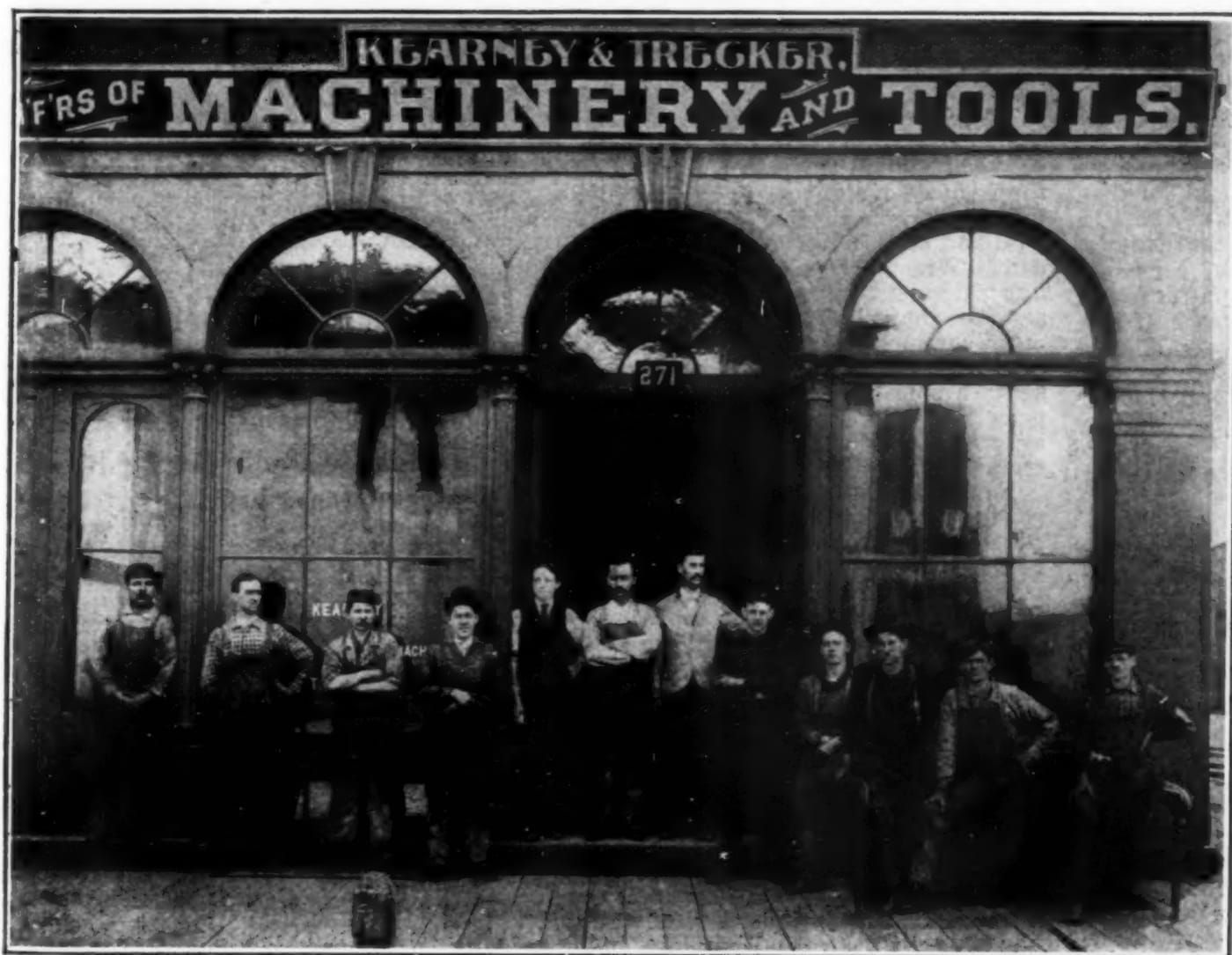
Halftone photograph of a group of men in work clothes, and a boy in the doorway, in front of a shop with arched windows. The sign across the top reads “Kearney & Trecker, Mfrs of Machinery and Tools”; the number 271 is over the door.
The first Kearney & Trecker shop, 271 Lake Street, Milwaukee. The two partners stand at the centre of the group; Herman Pufahl, third from the left, was still with the firm in 1923. American Machinist, 17 May 1923, p. 750i (public domain). · Read the source ↗

For their first year they build special machinery, much of it to their own designs. The firm starts with twelve employees.

“we shall build good machines here—at a profit, if we can—at a loss, if we must—but always, good machines!”

The founders’ early slogan, as the firm recalled it in Climaxing 42 Years, 1940 · Read the source ↗
Sources & notes 4

The 1923 article, with its photograph, puts the first shop at 271 Lake Street; a 2021 local history puts it above a shop on South 1st Street. The Machine Tool Hall of Fame biography has Trecker apprenticed at the Wilkin Manufacturing Co. before he joined Kempsmith; the local history has him apprenticed at Kempsmith. The local history also tells, as a legend, that Kearney agreed to start the business if Dewey won at Manila Bay.

Their first milling machine

Their experience with milling machines has convinced the partners that the machines suit quantity production. Their first milling machine comes out in 1899, and from then on they give all their attention to milling machines.

“Specialization may, in fact, be called the watchword of this firm. For when they design and put out a new machine it becomes standard and older types are abandoned.”

American Machinist, on the firm’s twenty-fifth anniversary, 1923 · Read the source ↗
Sources & notes 1

The 1923 article prints a photograph of the first machine but does not describe it.

A shop in West Allis

The Lake Street rooms are soon outgrown. In 1901 the firm builds a shop just outside Milwaukee, in the town of West Allis. The works grows around it: by 1923 it covers three acres of floor space, and the original building is still part of the plant. In 1942 the firm’s address is 6784 West National Avenue.

Sources & notes 4

VintageMachinery.org gives 1906 as the year the firm was incorporated; no record of that has been read. Joseph L. Trecker told Congress in 1943 that the present company was incorporated in 1920, as successor to the Kearney & Trecker Company.

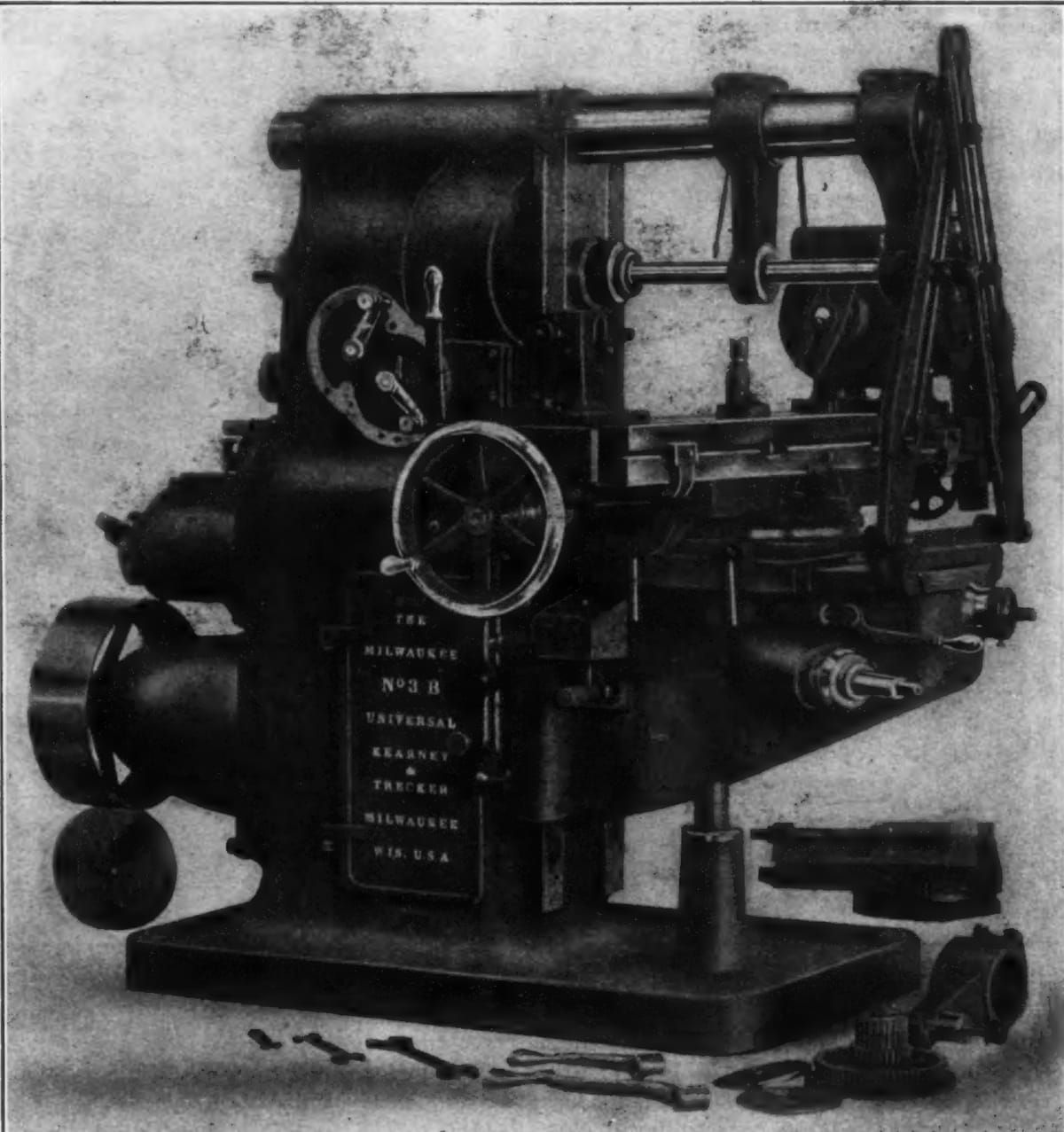
The Milwaukee No. 3-B, a high-power miller

The Iron Age describes the firm’s No. 3-B universal miller, a knee-type machine built to take heavy cuts at fast feeds. It runs at constant speed from a single pulley and is geared throughout; the firm has stopped building cone-pulley machines. The knee is cast without a hole through its top, as on the firm’s first machine, and a single overarm is held by braces.

Halftone of a heavy knee-type milling machine from the front left: a single round overarm with braces, a large handwheel on the knee, a drive pulley at the left, and a plate on the column lettered “The Milwaukee No 3 B Universal, Kearney & Trecker, Milwaukee, Wis. U.S.A.”. Wrenches and attachments lie on the floor.
The Milwaukee No. 3-B universal miller of 1908. The Iron Age, 30 July 1908, p. 291, Fig. 1 (public domain). · Read the source ↗

Speeds and feeds of the No. 3-B

Spindle speeds
1813 to 320 r.p.m., each about 20 per cent above the last
Table feeds
12½ to 16 in. per minute
The Iron Age, 30 July 1908, pp. 291–295. Read the source ↗

Because the feeds are driven from the constant-speed shaft rather than from the spindle, they are rated in inches per minute instead of inches per turn of the spindle, and a fast feed is available however slowly the spindle turns.

Sources & notes 2

Two overarms instead of one

In 1908 the No. 3-B still has a single overarm. By 1919 the firm is building horizontal machines with double overarms, two parallel round bars that carry the support for the outer end of the cutter arbor. They become the mark of a Milwaukee horizontal machine: American Machinist names the double over-arm among the firm’s standard features in 1923, and the No. 2 Model H has them.

The firm’s own literature dates them to 1912: the No. 2 Model H’s sales bulletin speaks of double overarms “since first invented by Kearney & Trecker in 1912”.

Sources & notes 6

The year 1912 comes from the firm’s later bulletin and from VintageMachinery.org; the firm’s patents have not been checked for it. The claim to have invented the double overarm is the firm’s own.

Between the wars

Motors in the base and machines for production

In 1920 the business is incorporated again, as successor to the Kearney & Trecker Company. Over the decade the workforce grows from 653 at the end of 1919 to 904 at the end of 1929, as motor vehicle, aircraft, electrical, radio and office-machine makers call for more production tools.

The firm’s own list of the decade’s work names a Production Service division for single-purpose tooling, the first standard milling machines with the motor in the base, power rapid traverse in six directions, and the Milwaukee Simplex and Duplex bed-type machines. Simplex and Duplex machines are in the firm’s lot book by 1929.

Sources & notes 4

The firsts are the firm’s own claims, from its anniversary book of 1940.

Twenty-five years

On 9 May 1923 E. J. Kearney addresses the National Machine Tool Builders’ Association at White Sulphur Springs as its president, urging the industry to prepare for the next depression. A week later American Machinist marks the firm’s twenty-fifth anniversary: the two partners still work together, and Herman Pufahl, one of the original workmen, is still with the firm.

“Since introducing the latter, for example, the cone pulley machine has been abandoned and they were for many years the only firm building nothing but the single pulley drive.”

American Machinist, 17 May 1923, on the single-pulley drive · Read the source ↗
Sources & notes 1

Lean years and a new design

The depression takes a heavy toll of the industries that make capital goods. Looking back in 1943, Joseph L. Trecker tells Congress that in the seventeen years from 1921 to 1937 the company made a profit in five, and lost about $800,000 on its operations overall.

Seventeen years, 1921–1937

Years in profit
5Of seventeen
Operating loss
$0.8mAbout $800,000 over the seventeen years to 31 December 1937
From Joseph L. Trecker’s written statement to the House Committee on Naval Affairs, 1943, pp. 1147–1148. Read the source ↗

The firm keeps designing. Its list for the 1930s includes milling with tungsten and tantalum carbide cutters, the solid back column, the centre-bearing spindle, the sponson-type knee, the cross-mounted motor, the sliding-head vertical machine, hydraulic controls, a rotary-head tool and die milling machine, and an astronomical divider that divides a circle into 1,296,000 parts, one second of arc each. E. J. Kearney, the secretary-treasurer, dies in 1934; Theodore Trecker remains president.

Sources & notes 4

The list of developments is the firm’s own, from 1940.

The Model K and Model H

The Model H and Model K at Cleveland

At the machine tool exposition in Cleveland the firm shows two series of knee-type machines. Beside the Model K, which a 1937 advertisement calls “the original High-Speed Milling Machine”, it introduces the Model H: two manufacturing sizes, No. 0 and No. 1, and the No. 2H light machine in plain, universal and vertical forms, with a 3 hp motor, sixteen speeds and sixteen feeds.

“The usual double overarm characteristic of Milwaukee milling machines is used on these models.”

American Machinist, 11 September 1935, p. 690 · Read the source ↗

The lot book, which records when the last machine of each production lot shipped, shows the first lots of the new machines completed that summer: fifteen No. 1-H manufacturing machines in July, twelve 3K horizontals of the “1935 Model” in August and No. 2K verticals in September. The first lot of No. 2H horizontals follows in April 1936. By January 1937 Model H machines are offered as plains, universals and sliding-head verticals, “the same as the Model K”.

Sources & notes 4

The 3 hp No. 2H of 1935 is the light machine later called the No. 2HL, not the 5 hp No. 2 Model H this exhibit shows. A lot’s completion date is the shipping date of its last machine, so a model can be in production earlier.

Joseph Armitage patents the drive

Joseph B. Armitage, who is the firm’s chief engineer by 1940, files two patents in June 1936. US 2,182,421 describes a vertical knee-type machine with a sliding head; US 2,215,684, filed two days later, is its horizontal companion, with double overarms.

Together they set out the drive the Model H uses: a motor across the column base driving through multiple belts to a clutch pulley with a starting clutch and brake, a speed box giving sixteen speeds, a take-off for feed and rapid traverse, and a knee feed box giving sixteen feeds from one crank and one dial. The assemblies match the No. 2 Model H’s parts manual one by one, often under the same names.

Sources & notes 4

The patents do not name a machine model; the match with the Model H is this exhibit’s comparison of the drawings with the parts manual. The 3 hp No. 2H had been shown nine months before the patents were filed.

The line widens

In June the first lot of five 2D rotary-head milling machines is completed. Its rotating head lets a toolmaker mill in metal the lines and arcs a draughtsman draws with straight-edge and compass. In October American Machinist uses the name No. 2HL for the 3 hp light Model H, and in November it reports two larger sizes, the 3H with a 7½ hp motor and the 4H with a 10 hp motor.

“The Series H machine features a solid back column, a cross-mounted motor, full automatic lubrication in the column and knee, and other improvements.”

American Machinist, 4 October 1939, p. 838 · Read the source ↗
Sources & notes 4

The No. 2 Model H

The 5 hp No. 2 Model H, the machine this exhibit shows in detail, is on sale by 1940. Its sales bulletin presents it as a new size between the light machines and the heavy-duty ones, built on the same principles as the larger Model K.

“It is stronger and sturdier than the so-called ‘light type’ miller, and yet it is not a heavy duty machine.”

Sales bulletin No. 714A, p. 1 · Read the source ↗

The No. 2 Model H in its bulletin

Motor
5 hpMounted crosswise in the column base
Spindle speeds
1635 to 1,400 r.p.m. as standard; 20–800 or 50–2,000 to order
Table feeds
16½ to 20 in. per minute as standard; the knee feeds at half these rates
Rapid traverse
150In. per minute for table and saddle; 75 for the knee
Sales bulletin No. 714A, pp. 2–7. The bulletin gives no table size or travels. Read the source ↗

To keep the price down, the bulletin says, the machine goes without a single-lever speed control, a pilot wheel for the overarms and duplicate feed controls at the rear. The firm’s 1940 anniversary book pictures a 2H universal, and a dealer later offers a 2H plain of 1940.

Sources & notes 4

The bulletin is undated. In 1935 the No. 2H was a 3 hp light machine; when the 5 hp machine appeared is not documented. The lot book lists 2H machines separately from 1H–2HL machines from 1939, in lots of 30 to 40, but does not give their power. The dealer’s list is in American Machinist, 28 September 1944.

Forty-two years

The firm marks its forty-second year with a book, Climaxing 42 Years, and 2,431 employees. Theodore Trecker is president; Joseph L. Trecker is vice-president, and Francis J. Trecker, a founder’s son, is assistant chief engineer under Joseph B. Armitage. More than a hundred apprentices are in training, and new 5H heavy-duty machines are announced for the year.

Employees

1898
12The original workforce
1909
151From the firm’s chart
1919
653By the end of the year
1929
904By the end of the year
1939
1,352From the firm’s chart
1940
2,431In the anniversary year
Climaxing 42 Years, 1940, p. 3. The firm’s own figures. Read the source ↗
Sources & notes 1

The book also calls the works the world’s largest plant given only to milling machines; that is the firm’s own claim.

The war

Bigger lots and a bigger plant

Production lots grow. In the 1930s the lot book records machines a dozen or a few dozen at a time; in 1940 it records 2H horizontals forty at a time and, in July, two lots of eighty 2K–3H horizontals.

Machines in one production lot

August 1935
123K horizontals, the first lot of 1935 Model K machines
July 1940
802K–3H horizontals, in each of lots 2821 and 2844
Kearney & Trecker lot book, publication 266-795. Read the source ↗

The plant grows to match. Ground is broken on 20 December 1939 for a 70,000 sq ft addition to the 220,000 sq ft works, and the first machine tool is running in it 44 days later. A further 20,000 sq ft follows; by November 1941 about 100,000 sq ft has been added since the start of 1940. In February 1942 the firm decides on a defence plant addition, whose plans Francis J. Trecker administers.

Inside, the departments are rearranged. The old plant was grouped by type of machine tool; the new one groups the machines that make each part, so that more than forty operations on the knee casting are done in the knee department. Among the new workers, 579 semi-skilled and unskilled workers learn the operations beside veteran employees.

Sources & notes 4

The sources do not say who ordered the machines in these lots. The 1940 figures are from The Iron Age of 26 September 1940; it gives 1,506 employees when ground was broken.

Milwaukee machines on defence work

Automotive Industries describes Continental Motors’ Detroit plant, rebuilt to make R975 radial engines for military tanks. Its factory routings name Kearney & Trecker machines for milling cylinder heads and crankcases, several of them No. 2-H machines.

“No. 2-H Kearney & Trecker plain horizontal milling machine, 2-spindle”

Routing for milling the rocker box faces of the cylinder head, Automotive Industries, 1 December 1941, p. 22 · Read the source ↗

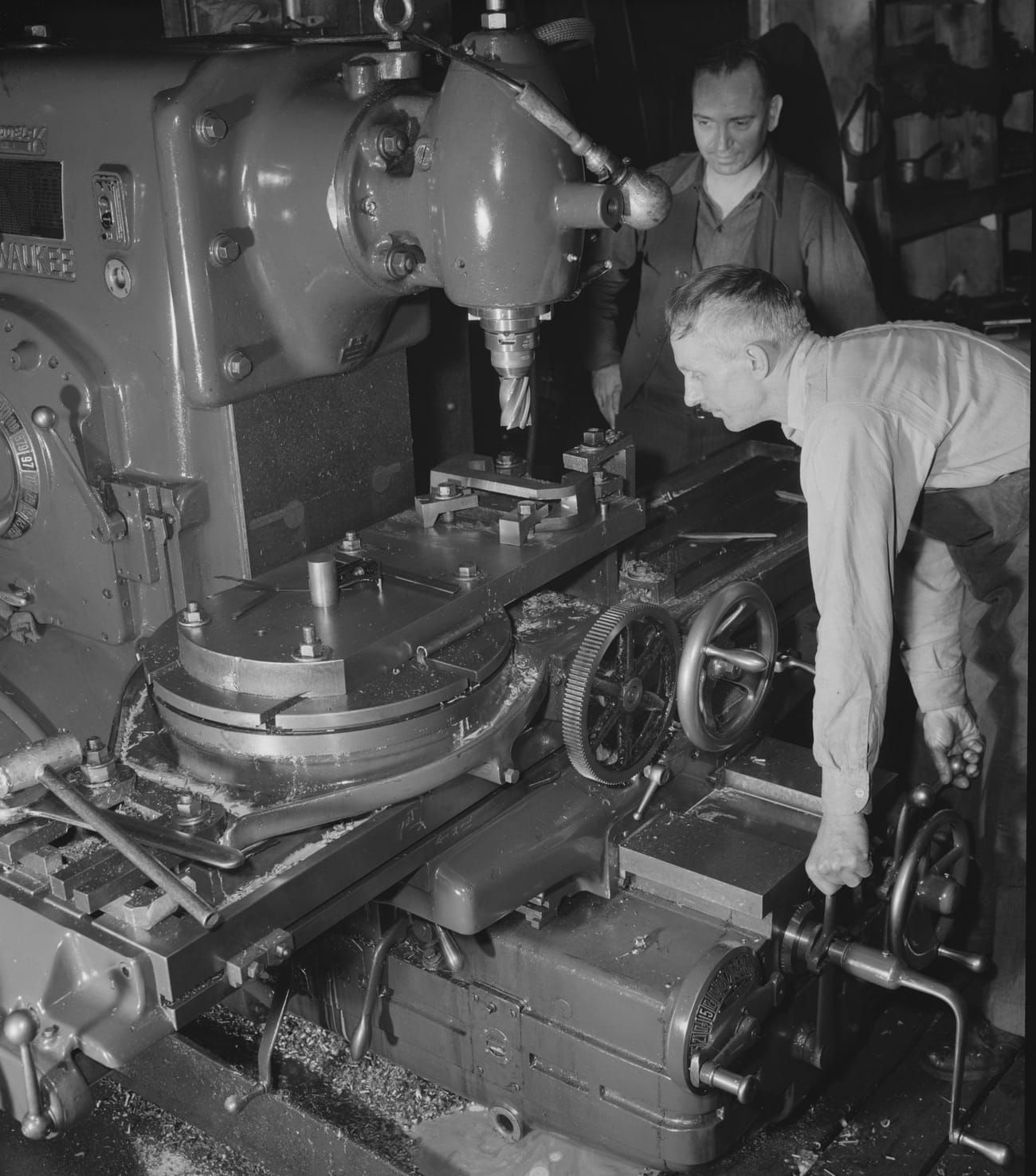
The same month Alfred T. Palmer photographs a Milwaukee Model K vertical machining axle brackets for a 37 mm anti-aircraft gun carriage at Aetna in Ellwood City, Pennsylvania.

Black-and-white photograph of two men at a large vertical milling machine with a rotary table. One leans over to turn a crank at the knee while the other watches the cutter. The column carries cast lettering ending “…WAUKEE”.
A Milwaukee Model K vertical with a rotary table machines axle brackets for an anti-aircraft gun carriage, Ellwood City, Pennsylvania, December 1941. Alfred T. Palmer. Library of Congress, Prints & Photographs Division, FSA/OWI Collection, LC-USE6-D-001998. · Read the source ↗
Sources & notes 2

The routings print “No. 2-H” without the horsepower. In late 1941 the firm’s 3 hp machine was called the No. 2HL, so the 5 hp No. 2 Model H is the likely meaning. The photograph’s caption does not name the machine; the model is read from the lettering on its column.

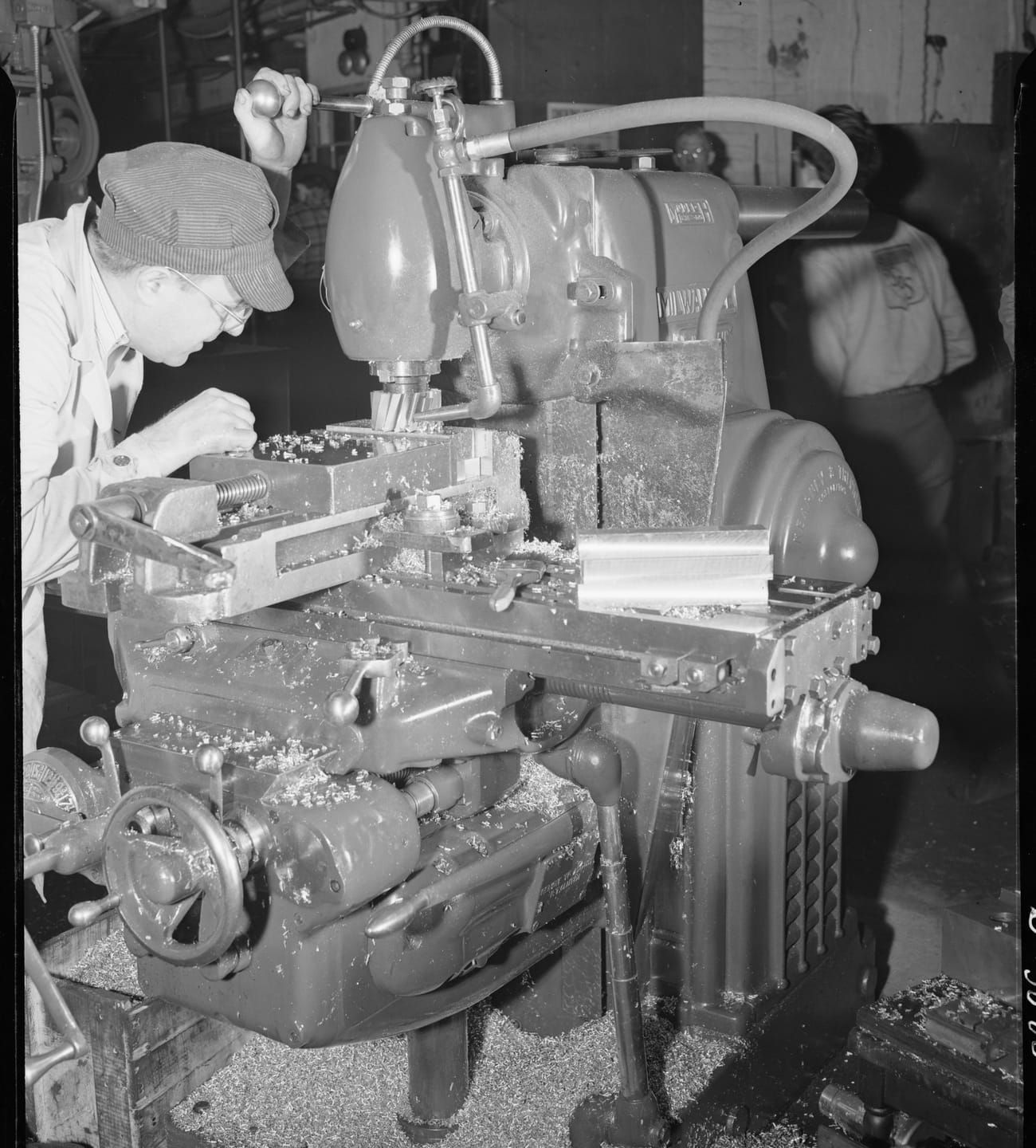
A Model H vertical mills wing parts

Edward Gruber photographs a Brooklyn plant that has turned from paper-making machinery to aircraft wing parts. At a Milwaukee Model H sliding-head vertical, an operator mills aluminium stub wing blocks.

Black-and-white photograph of a man in a striped cap and glasses leaning over the table of a vertical milling machine, holding the head’s lever while a cutter works a block clamped in a vise. Chips cover the table and the floor; the column carries the cast word Milwaukee.
An operator mills aluminium stub wing blocks on a Milwaukee Model H sliding-head vertical, Brooklyn, April 1942. Edward Gruber. Library of Congress, Prints & Photographs Division, FSA/OWI Collection, LC-USE6-D-005080. · Read the source ↗
Sources & notes 2

The caption does not name the machine; the model is read from the cast lettering on its column, and the size, probably No. 2, from its proportions. It is the only wartime photograph found of a Model H with its operator.

War finish

The War Production Board’s order L-108 limits how new machine tools may be finished: one coat of primer or sealer, no filler, no more than two coats of paint, and no colour but “old machine tool gray” for the last coat.

A surviving No. 2 Model H plain carries the order on its column, cast in the iron where other machines read MILWAUKEE: WAR FINISH / AS DIRECTED BY / W.P.B. ORDER No. L-108.

“Gone are the gleaming surfaces that once were the proud exteriors of Milwaukee Milling Machines. War paint is the order of the day.”

Kearney & Trecker advertisement, American Machinist, 29 April 1943 · Read the source ↗

In June 1944 General Motors’ master mechanics tell American Machinist that the emergency finish is not satisfactory and that they want the pre-war finish back after the war.

Sources & notes 4

The order’s terms are from a paint maker’s summary in American Machinist, 28 October 1943. The cast panel is on a privately owned machine, photographed by its owner in 2016; the last digit of the order number is slightly blurred.

Bonds, posters and the labour-management committee

In August 1942 The Iron Age shows three Kearney & Trecker employees, one in bib overalls, with the car streamers the corporation supplies for its 10 per cent war bond drive: “I’m a 10% war bond man”.

The firm’s labour-management committee puts up posters against absenteeism. One, photographed for the Office of War Information, reads “Mother loses 3 sons at Pearl Harbor / Dedicated to each of you / 115 men absent after payday!”. Twelve posters lettered with the firm’s name survive in the government’s collections: reminders to return tools to the crib, appeals to buy bonds and keep producing, and a memorial for Decoration Day 1942. Two use racist caricatures of Japanese people, and two more caricature the Axis leaders.

Sources & notes 4

No source read gives the number of women or Black workers at Kearney & Trecker, or describes their work there; the award programme of September 1942 is addressed to “the men and women” of the firm. That the posters in the National Archives were the committee’s is inferred from the Office of War Information caption.

Attachments instead of new machines

With new machines slow to come, the firm advertises an Emergency Production Service Department. Its August 1942 advertisement shows a plain Milwaukee fitted with a universal milling attachment, a dividing head and a low lead attachment, cutting a spiral clearance on a cutter blank, for less than half the price of a new machine.

“Wartime secrecy demands that we do not reveal the name of the plant concerned and the machining operation involved, but the basic facts can be presented.”

Kearney & Trecker advertisement, American Machinist, 15 October 1942 · Read the source ↗

The October advertisement tells of a large manufacturer who had to mill tank parts vertically while all his vertical machines were busy; Universal Milwaukee Milling Attachments turned his plain machines into vertical ones.

Sources & notes 2

These are the firm’s advertisements. They do not say whose plain machines were converted, or which models.

The Army-Navy “E”

On 15 August 1942 Under Secretary of War Robert P. Patterson tells Theodore Trecker that the Army-Navy Production Award has been granted to the company and its employees. It is presented at the factory on 9 September: Rear Admiral Charles W. Fisher gives the pins and Brigadier General William H. Harrison the flag, with Governor Julius P. Heil present, and the ceremony is broadcast over WEMP.

“On behalf of the 4600 loyal workers in this organization, I offer our thanks and express our determination for the future.”

Theodore Trecker to Robert P. Patterson, 28 August 1942, printed in the award programme · Read the source ↗

The workforce has nearly doubled since 1940. Across the country the award went to 4,283 facilities, and in the Milwaukee area to 68 companies.

Sources & notes 4

The national and Milwaukee figures are from the Milwaukee County War Memorial Center, whose article does not name the firm. Whether the firm later won stars for renewed awards was not found. Its advertisement of October 1942 already carries the “E” pennant.

Joseph L. Trecker testifies on war production

The House Committee on Naval Affairs, investigating the progress of the war effort, hears Joseph L. Trecker, the firm’s executive vice-president and a director of the National Machine Tool Builders’ Association. His written statement calls Kearney & Trecker one of the three largest makers of milling machines in the United States, which together supply a major proportion of them.

Output, as Trecker gave it

1942
12×More than twelve times a hypothetical normal year’s output
1921 – 1937
½Seventeen years’ output was worth about half that of 1942 alone
Joseph L. Trecker’s statement, pp. 1146–1147. The figures are his; the volume’s tables have not been read. Read the source ↗

He expects the industry’s sales to fall, citing the association’s estimates: from $1.3 billion in 1942 to $1.0 billion in 1943.

“I do not mean to subscribe that it is a war industry, however; it is a peace industry.”

Joseph L. Trecker, testimony, p. 902 · Read the source ↗
Sources & notes 1

The hearing volume was read through its table of contents and passages found by searching it, with their printed page numbers; its page images could not be opened. The firm’s table of shipments for 1913–1942 (p. 1301 and after) is still unread. The supplementary statement is dated 4 August 1943.

Kearney & Trecker slots wing hinges

The firm machines aircraft parts itself. American Machinist describes how it slots forged SAE 4340 steel wing hinges, in four sizes, for carrier-based aircraft. Carbide-tipped cutters have replaced high-speed steel ones and saved 95 per cent of the machining time, and an air-operated fixture has cut the time to load each piece.

Loading the fixture

Hand-operated fixture
300 sLoading time
Air-operated fixture
40 sAbout, loading time
American Machinist, 12 April 1945, p. 122, Fig. 1. Read the source ↗
Sources & notes 1

The article does not name the milling machine used; its photograph shows an arbor-mounted cutter on a horizontal machine.

Model H machines in a laboratory shop

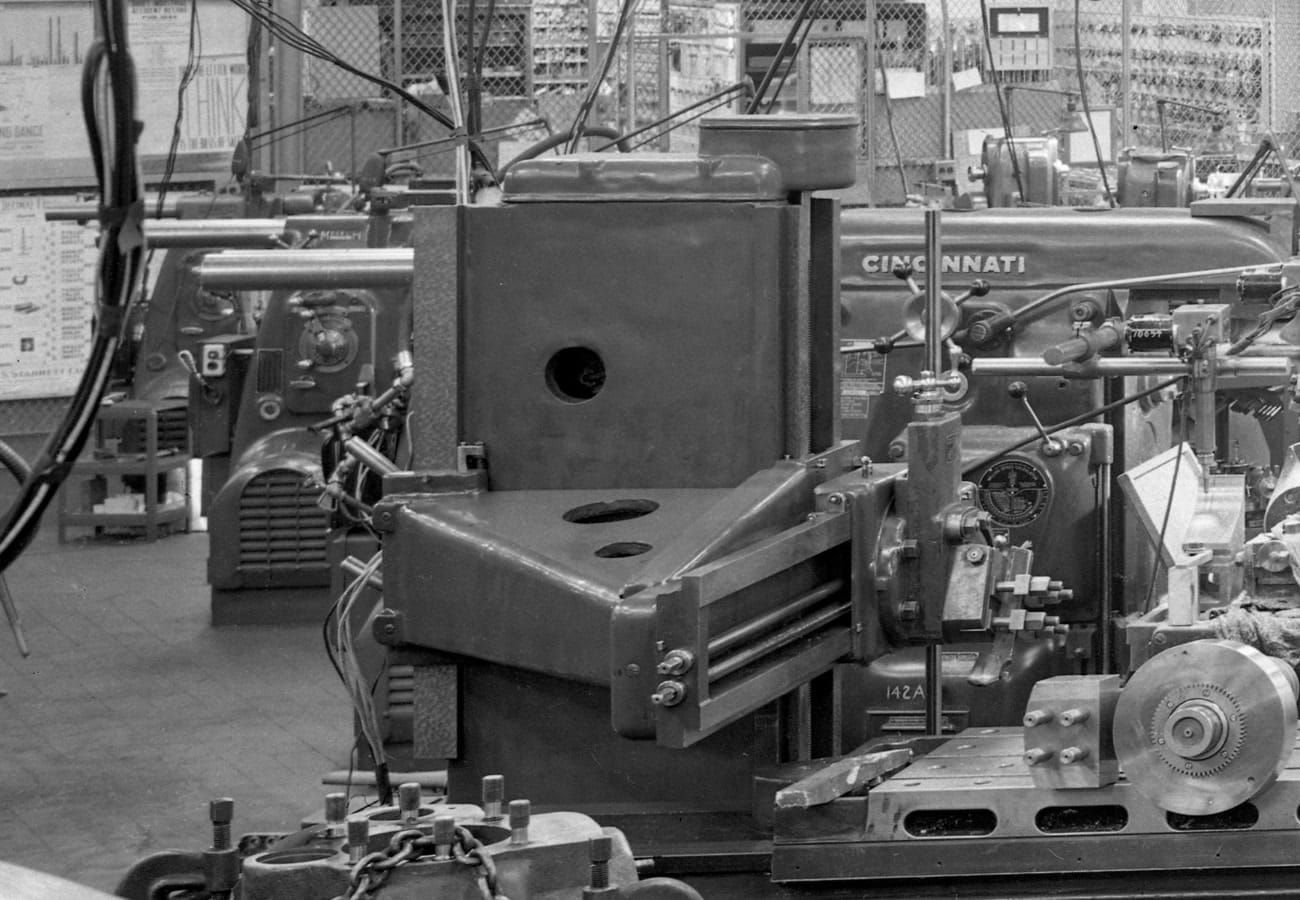
A photographer at the NACA’s Aircraft Engine Research Laboratory in Cleveland, Ohio, records its machine shop from end to end. Along the wire-mesh tool crib stand two Milwaukee Model H horizontal machines, one behind the other, in a row of knee-type millers with a Cincinnati.

Black-and-white photograph of a machine-shop floor: a shaper in the foreground; behind it the columns of two milling machines with twin round overarms and louvered doors; a Cincinnati milling machine at the right; a wire-mesh tool crib at the back.
Behind the shaper, the columns of two Model H horizontals, with their twin overarms and louvered motor doors; the Cincinnati at the right carries the equipment number 142A. Cleveland, 22 May 1945. NACA photograph. National Archives, 255-GRC-1945-C-10197 (detail). · Read the source ↗

The same photographs show the rest of the shop: rows of toolmakers’ benches, fluorescent lights under the roof trusses, a notice board with an accident-record chart, and a flag hung from a girder.

Sources & notes 1

The laboratory was a federal research establishment, not a production plant. Neither the size of the Model H machines nor whether they are plain or universal can be seen.

After the war

The Model H after the war

The firm advertises 99 models, from 3 to 50 hp. The No. 2 Model H is offered as a plain, universal or vertical machine, and now also with automatic cycle in plain and vertical forms.

“Model K machines are general all-purpose machines. Model H machines are the intermediate type.”

Kearney & Trecker advertisement, American Machinist, 2 January 1947 · Read the source ↗
Sources & notes 3

Both books are undated. The “Milwaukee 14” postal zone on them places their printing in 1943 or later, and HR-23’s automatic-cycle parts make it a post-war edition.

Francis J. Trecker becomes president

Theodore Trecker, who has run the company since 1898, is succeeded in July 1947 by Francis J. Trecker. A Cornell engineer who had worked for Pratt & Whitney Aircraft and Pratt & Whitney Machine Tool, and for two years on defence subcontracting in Washington, he moves all controls research to the main plant and raises spending on research and development.

Sources & notes 2

Machines for the aircraft industry under numerical control

According to Francis Trecker’s Hall of Fame biography, the firm begins producing numerically controlled profilers and skin mills for aircraft work in 1950. In 1953 it joins Hughes Tool, under the Aircraft Industries Association, to develop a numerically controlled transfer machine, the firm’s engineering development No. 74.

In July 1957 American Machinist counts 105 large machine tools with continuous-path numerical control, bought by the Air Force for aircraft plants and built by four firms: Cincinnati Milling Machine, Giddings & Lewis, Kearney & Trecker and Morey. Bendix supplies the controls for the Kearney & Trecker machines.

Sources & notes 3

The chronology used here dates MIT’s first numerically controlled milling machine to 1952, so the biography’s 1950 should be read with care.

The No. 2 Model CH

The firm announces three new knee-type machines, the No. 1 CH, No. 2 CHL and No. 2 CH, stressing “the new larger working ranges”. The 5 hp No. 2 CH has a 50 by 12 in. table, a No. 50 spindle taper as standard and sixteen speeds from 25 to 1,500 r.p.m.; its vertical version has Mono-Lever table control and automatic cycle.

Sources & notes 1

The advertisement does not say when the No. 2 Model H was last built.

Theodore Trecker dies

The surviving founder dies. Born in 1868 in Peru, Illinois, to parents who had come from Germany, he had run the company from 1898 until 1947; he is elected to the Machine Tool Hall of Fame in 1988. A local history gives the firm 2,250 workers on a 95-acre site at his death.

Sources & notes 2

The workforce and site area are from a 2021 local history that does not give its source.

Wallace Brainard joins from Hughes

Hughes has contracted with the firm for a line of three machines with Hughes controls and a tool changer. Wallace E. Brainard, a self-taught engineer who had done electro-hydraulic and tracer-control work at Vultee, Northrop and Hughes, moves with the contract to Kearney & Trecker as Director of Technical Operations. When the Hughes control proves unsatisfactory and the contract ends, he leads a team that designs one machine combining the tool changer with a General Electric numerical control.

Sources & notes 2

The Milwaukee-Matic

On 27 June 1958 Brainard and four colleagues file a patent for a machine tool that changes its own cutting tools. In October the firm unveils the Milwaukee-Matic at the American Institute of Electrical Engineers’ machine tool conference in Hartford, Connecticut. It holds about thirty tools in a circular magazine, changes them automatically, and mills, drills, reams, taps and bores on one machine.

The Milwaukee-Matic Model II

Tool magazine
30Tools, in one report; another gives 31
Tool change
8.5 sAn arm grips the old tool and the next and swaps them
As reported in Automotive Industries, 15 November 1958, and American Machinist, 15 December 1958, through the chronology cited. Read the source ↗

It goes on sale in December. The Model II works from General Electric paper-tape control, with travels of 24, 21 and 16 in. on its three axes and an indexing table to turn the work. Later accounts call it the first machining centre.

Sources & notes 2

These details come through a chronology that cites the period trade press. A Japanese history gives 1957 for the machine. The tool-changer patent, US 3,052,011, was granted on 4 September 1962.

The first machining centres ship

The first Model IIs are built in 1958 at the firm’s Highway 100 plant, in lot 8680, entered in the lot book as “ED #74 Servo Control Milling”. The first is shown to employees in December 1958. The second ships in January 1959 to General Electric’s control division at Waynesboro, Virginia, as a test machine for its controls; GE’s president comes to Milwaukee to accept it.

“This was then the ‘official’ first MM II Machining Center sold commercially.”

Robert Pipes, from the firm’s lot records, 2011 · Read the source ↗

That year machines go to GE at Schenectady, to United Nuclear for machining fuel elements, to CVA in England, to Colt Industries, and to Raytheon, where one makes gimbal blocks for Hawk and Sparrow missiles. In January 1959 an advertisement calls the machine “a flexible automated machining center”; just over a year after its launch the firm reports 55 orders and 30 deliveries.

Sources & notes 2

The account of the first machines is compiled from the firm’s lot records and a former employee’s recollections. The phrase “machining center” had been used earlier for an area of a factory.

Cross & Trecker

Kearney & Trecker and the Cross Company of Fraser, Michigan, a builder of transfer machines, agree on 2 October 1978 to come together under a holding company, Cross & Trecker Corporation; both become its subsidiaries on 13 February 1979. In September 1979 the Department of Justice sues under the Clayton Act to undo the merger, citing the markets for machining centres and head changers.

Kearney & Trecker in 1978

Net sales, $ million
96.3About; over half of it machining centres and head changers
Net income, $ million
8.2About
From the Department of Justice complaint, filed 25 September 1979. Read the source ↗
Sources & notes 2

The outcome of the suit is not in the sources read; the company continued as Cross & Trecker until 1991.

Giddings & Lewis buys Cross & Trecker

Francis J. Trecker, who had led the firm into numerical control, dies in 1987. That year Kearney & Trecker’s president, William J. Fife Jr., moves to Giddings & Lewis of Fond du Lac, Wisconsin. On 31 October 1991 Giddings & Lewis completes its purchase of Cross & Trecker and becomes the largest machine-tool maker in the United States.

Sales before the merger

Cross & Trecker, $ million
550About; the third-largest machine-tool business in the country
Giddings & Lewis, $ million
243In 1990; the fifth-largest
United Press International, 8 November 1991. Read the source ↗
Sources & notes 2

The doors close

Kearney & Trecker closes in 1993, after Japanese and German competition had worn away its sales of milling machines through the 1980s.

Sources & notes 3

Both sources for 1993 are secondary; VintageMachinery.org cites an interview with a long-serving employee, Ron Grundy. Wikipedia gives 1991, the year the firm passed to Giddings & Lewis.